Construction is different from fiber
Cotton, wool and polyester tell you what a textile is made from. Woven, knitted and nonwoven tell you how its fibers or yarns are put together. Both details matter. A cotton curtain and a cotton jersey cushion cover may feel and behave quite differently, even though they share the same fiber. Finishes, fabric weight and backing can make a difference too.
Knowing the construction helps you ask useful questions: Will this material hold a crisp shape or stretch around a cushion? Might a cut edge unravel? Is it likely to wrinkle or change shape after washing? Construction offers clues rather than guarantees, so use it alongside the care label and the feel of the finished item.
Woven textiles: crossing yarns for structure
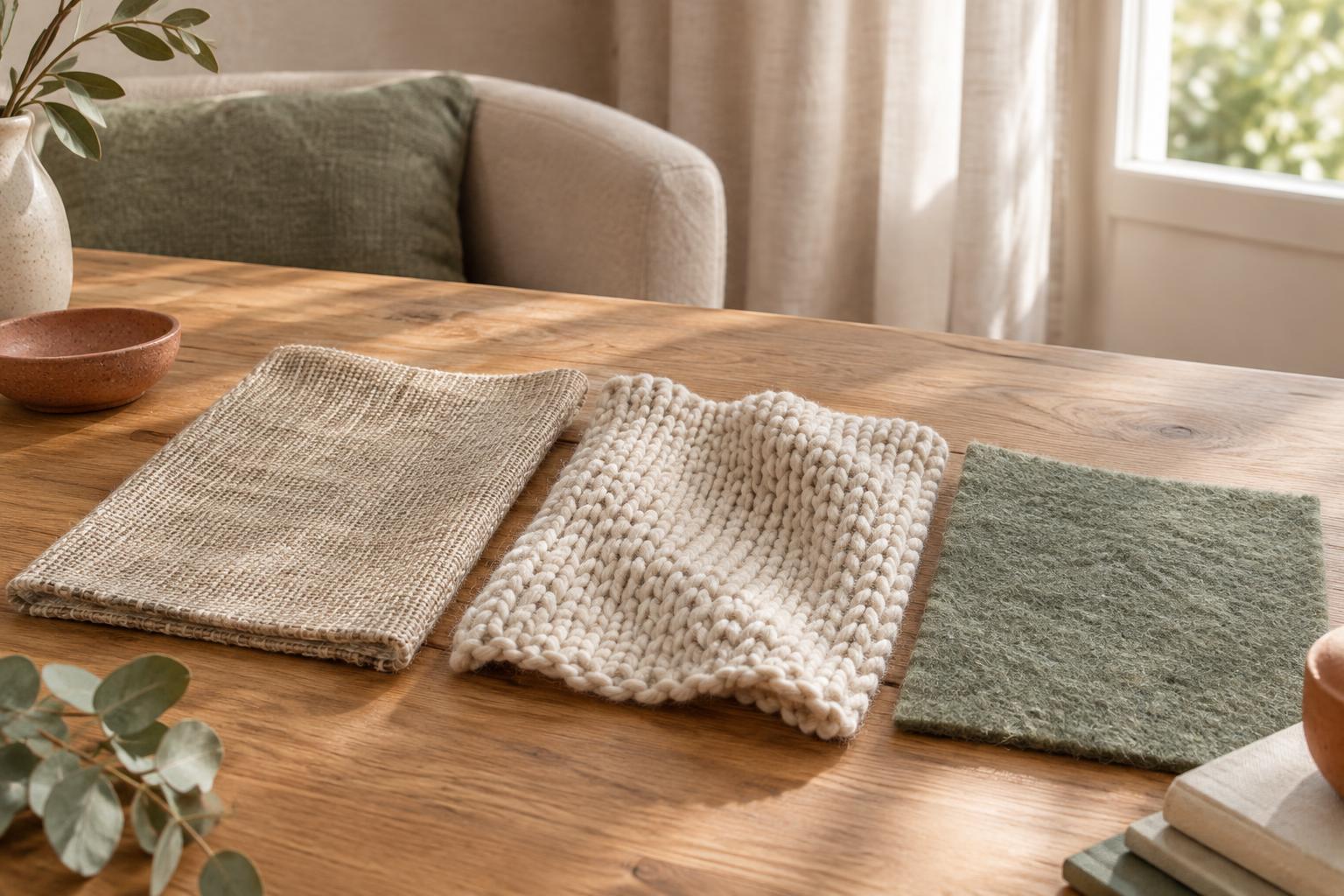
Woven fabric is made by crossing lengthwise yarns, called warp, with yarns running across them, called weft. Plain weave, twill and satin weave arrange those crossings differently, creating different surfaces and degrees of flexibility. Many curtain fabrics, table linens, upholstery covers and bed linens are woven. A close weave can look neat and hold its shape well, while a loose weave may feel airy and relaxed.
Most woven fabrics have limited stretch unless they include elastic fibers or are cut on the diagonal, known as the bias. Their cut edges may fray, so hems and seams often need finishing. For a tailored curtain or a cushion with defined corners, a stable woven fabric can be helpful. For a soft throw, a loosely woven fabric may provide the drape you want, though it may also be more prone to snagging.
Knitted textiles: loops that move
Knitted fabric is built from interlocking loops of yarn. Those loops can shift, giving many knits natural stretch and a softer, more flexible drape. You may find knits in throws, blankets, cushion covers, mattress covers and some fitted furnishings. A chunky knit can add visible texture; a fine knit can create a smooth, pliable surface.
Stretch is useful when a cover needs to fit over a shape, but it can make a textile less crisp than a comparable woven fabric. Some knits curl at cut edges, and loose loops can catch on claws, jewelry or rough hardware. Knits also vary widely: a dense knit may feel firm, while an open knit may need gentle handling. If you are buying a removable cover, check how it fastens and whether the maker gives instructions for drying it without distorting its shape.
Nonwoven textiles: fibers joined without weaving or knitting
Nonwoven textiles are made by joining fibers into a sheet rather than crossing yarns or forming loops. The fibers may be entangled, bonded with heat or held together in another way. Felt is a familiar example. Other nonwovens appear as furniture dust covers, lining materials, carpet underlays and interfacing used to give a sewn project extra body.
Nonwovens are a broad group, not a single feel or quality level. Some are soft and sturdy; others are thin and intended for a supporting role rather than frequent handling. They generally do not fray like a cut woven edge, but that does not mean they cannot tear, pill or lose their shape. Before using a nonwoven for a washable project, confirm that it can tolerate the same care routine as the outer fabric.
How to choose and care for each type
Start with the job the textile needs to do. For a curtain that should hang in straight folds, consider a woven fabric with suitable weight and drape. For a cozy cover that needs some give, a knit may be appealing. For padding, lining or added structure inside a project, a nonwoven may be the practical choice. Touch a sample if possible, and look at both sides: the backing or finish can affect how a fabric behaves as much as its visible surface.
Care should follow the finished item’s label, not a rule based on construction alone. Test any cleaner on an inconspicuous area when appropriate, blot spills rather than rubbing them in, and avoid stretching wet fabric while it dries. For removable covers and DIY projects, allow for possible shrinkage or shape changes before making a precise fit. Understanding the three constructions will not predict every outcome, but it makes choosing and maintaining home textiles much less of a guessing game.