Check what has worn out
When one corner of a fitted sheet slips off the mattress, the elastic is a good place to start—but it is not the only possible cause. Look along the curved edge for elastic that has lost its spring, snapped, or pulled free from its stitching. Then check the fabric and corner seam. If the fabric has torn or the seam has opened, mend that damage before testing the elastic again.
Turn the sheet inside out and follow the elastic away from the loose corner. Some sheets have elastic inside a folded fabric channel, called a casing. Others have elastic stitched directly to the edge. It may run only around each corner or continue around the entire sheet. A short corner section is usually the simplest to replace. If a continuous band is worn throughout, replacing only one piece may leave the other corners loose.
Gather supplies and plan the repair
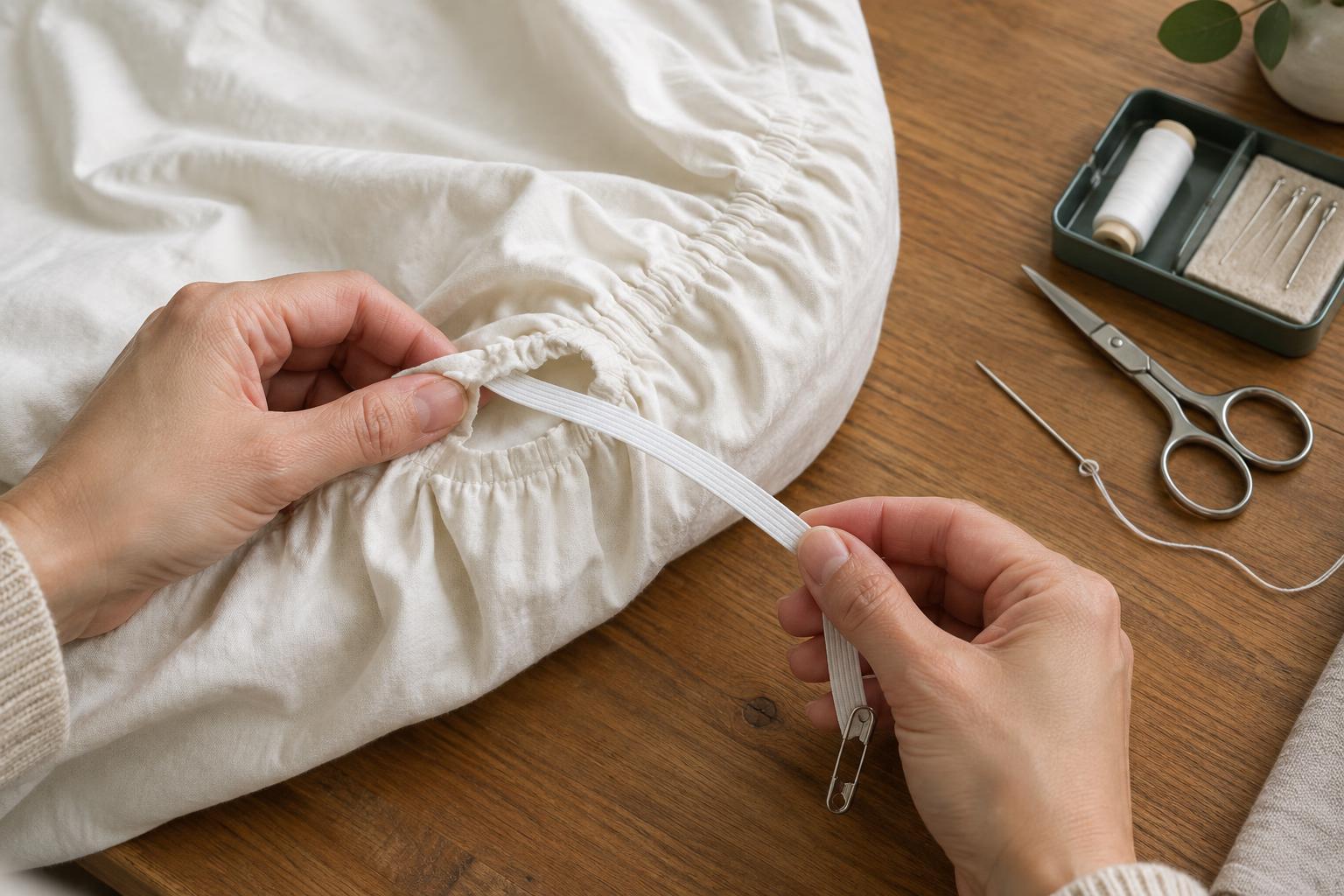
You will need replacement elastic, scissors, a seam ripper, pins or clips, a needle and thread or a sewing machine, and a safety pin if the elastic sits inside a casing. Choose elastic close in width to the original, provided it fits comfortably inside the casing or along the sheet edge. A wide, stiff band can make a light sheet edge bulky; a very narrow band may not hold it as securely.
Before cutting anything, note where the working elastic is anchored and how much of the corner it gathers. If another corner still fits well, use it as a guide rather than copying the length of stretched-out elastic. Cut the replacement a little longer than you expect to need so you have room to adjust and secure its ends. Test its stretch by hand: it should gather the corner without pulling the fabric into a tight knot.
Replace elastic inside a casing
For elastic enclosed in a casing, open a small section of stitching near one end of the worn corner band. Work carefully so you cut thread, not sheet fabric. If the elastic is anchored at both ends, release those stitches and pull out the worn piece. Keep track of the openings or anchor points; they show where the new elastic needs to sit.
Attach a safety pin to one end of the new elastic and guide it through the casing, bunching the fabric over the pin as you go. Keep the free end outside the opening so it cannot disappear into the channel. Make sure the elastic has not twisted, then pin both ends at their anchor points. Spread the gathers evenly, check the fit on the mattress, and adjust the length if needed. Sew each end firmly in place with several passes of stitching, then close the opening you made.
Replace elastic stitched to the edge
If the elastic is sewn directly to the sheet, remove the stitches holding the worn section while leaving sound fabric and nearby elastic intact. Do not pull hard on old thread: it can tear a thin or well-washed hem. Pin the new elastic at the same end points, distributing the fabric evenly between them. If you are sewing by machine, a zigzag stitch can stretch with the elastic; stretch the elastic gently to meet the fabric as you sew, without stretching the sheet itself.
For a hand-sewn repair, use small, secure stitches that catch both the elastic and the folded sheet edge. Work a short stretch at a time and keep the gathers even. Sew across each end more than once so the join does not take all the strain in a single stitch. If there is no sound place to anchor the new piece, you may need to replace a longer run of elastic instead.
Test the fit and care for the repair
Put the sheet on the mattress and check the repaired corner alongside the others. The edge should tuck under without excessive force, and the corner should stay in place when you smooth the sheet. If it still slips, shorten the replacement slightly. If it is difficult to pull on or the fabric is strained, give the elastic more length. Making that adjustment before trimming the spare ends is easier than starting over.
After the fit feels right, trim loose threads and check that no safety pins remain in the casing. Follow the sheet’s care label when washing and drying; excessive heat can be hard on some elastic. If the fabric around the corner has become too thin to hold stitches, a fresh elastic band may not be a lasting fix. Otherwise, this small repair can make a comfortable sheet useful again.