Understand what you are removing
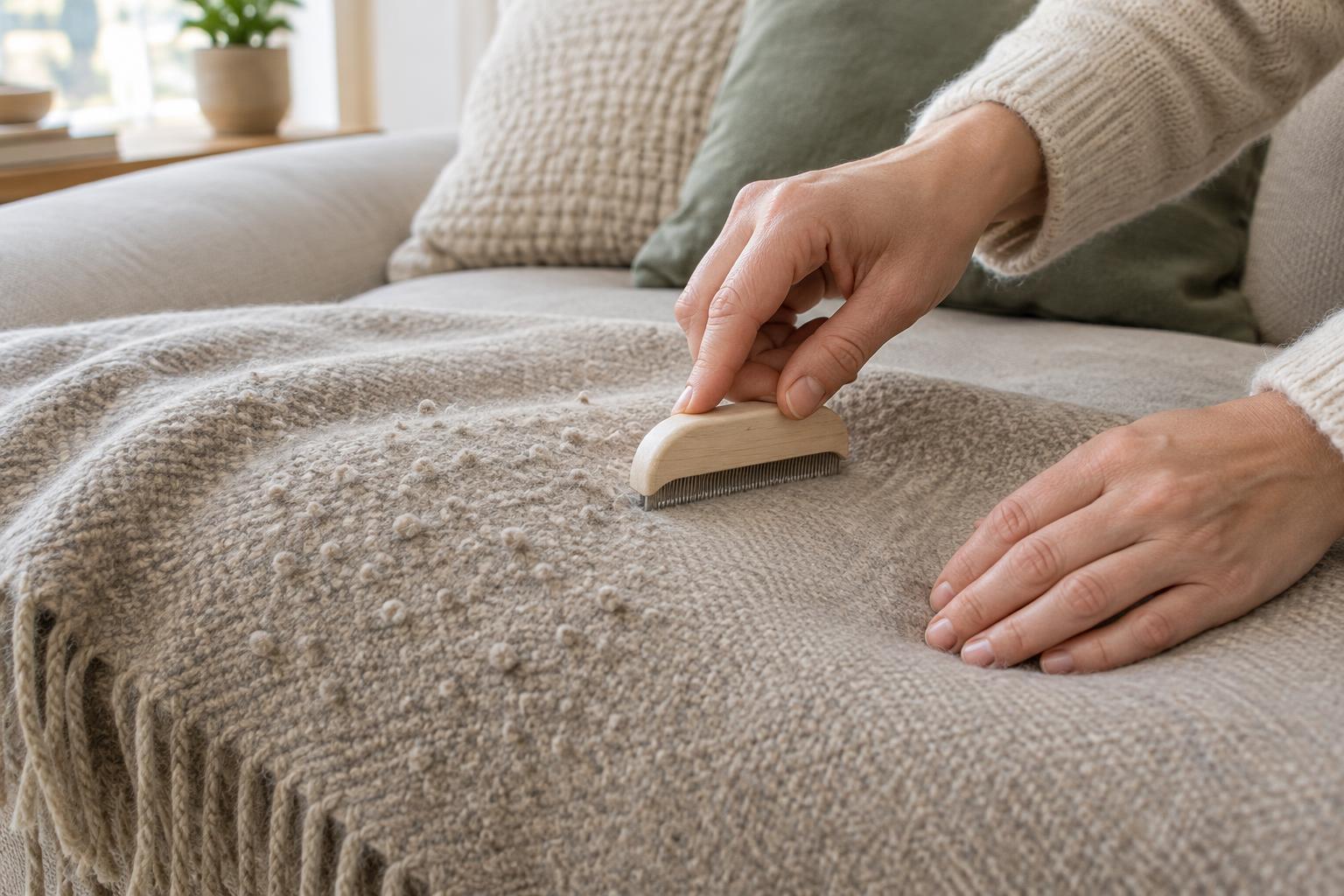
Pills are small balls of fiber that form when loose ends tangle on a fabric’s surface. They often appear where fabric rubs against fabric, skin or another object: the arms of a chair, the seat of a sofa or the middle of a well-used throw. Removing them can tidy the surface, but it will not necessarily prevent new pills from forming.
Look closely before you begin. A pill usually sits above the fabric and can be distinguished from the threads that make up the weave or knit. If a bump seems to be part of a looped texture, leave it alone. Pulling at a loop can create a snag or open a gap that is more noticeable than the original bump.
Prepare the fabric and test a small area
Check the care label if there is one, and work on clean, completely dry fabric. Good light helps you see what the tool is touching. For a removable cushion cover or throw, spread the fabric flat without stretching it. On upholstery, keep the section you are treating as smooth as possible and work around seams, piping and buttons rather than across them.
Test your chosen method in a less visible spot first. Make a few light passes, then inspect the area from several angles and run a hand over it. Stop if you see fuzz being lifted from the fabric itself, a change in sheen or texture, or any sign of a snag. Delicate, loosely woven, looped or heavily textured materials may be better left as they are than treated with a tool.
Choose the least aggressive removal method
For a few large, clearly raised pills, small sharp scissors offer control. Hold the fabric steady and snip each pill above the surface, taking care not to cut a supporting thread. Do not pull pills off with your fingers: a pill may still be attached to fibers in the cloth. If there are many pills, scissors can become slow and tiring, which makes accidental cuts more likely.
A fabric shaver can cover a broader, fairly even area. Use a clean device with an intact guard, and follow its instructions. Start with the gentlest setting or greatest clearance available, let the guard rest lightly on the surface, and move in short passes without pressing down. Check the collection chamber and blades regularly; a clogged shaver may drag rather than cut cleanly. Keep it away from seams, embroidery, loose threads and raised patterns.
A fabric comb is another option for sturdy, smooth surfaces, but its teeth can catch on open weaves and knits. If you use one, draw it lightly in the direction the fabric lies and inspect after each pass. Avoid improvising with a household razor: an exposed blade makes it easy to slice into the cloth, especially where the surface curves.
Treat textured fabrics and upholstery with extra care
Some surfaces are difficult to distinguish from pills. Bouclé, for example, is made with visible loops and nubs; vigorous combing or shaving may remove part of its intended texture. Velvet and other pile fabrics can show changes in direction or sheen after rubbing. When the fabric’s structure is unclear, try removing only the most obvious detached pills with scissors, or leave the area untouched.
Upholstery cannot always be laid flat, so take particular care on chair arms and curved cushions. Work in small sections with gentle pressure, and pause often to check the result. Never force a tool over piping or into a crease. If the fabric is thin, fraying or already snagged, pill removal may cause more damage than the pills themselves.
Keep the refreshed surface looking tidy
After removing pills, lift away the cut fibers with a soft brush or a vacuum attachment used gently, as appropriate for the fabric. Inspect the area again before repeating the process. A few remaining pills are preferable to thinning the surface through repeated passes.
To limit future friction, rotate loose cushions when practical, keep throws from dragging over rough edges and follow the item’s washing instructions. When machine washing is permitted, turning a removable textile inside out and avoiding an overloaded drum may reduce unnecessary rubbing. Pilling is sometimes a normal part of use, so aim for careful maintenance rather than a perfectly smooth surface at any cost.