Start with the table you actually use
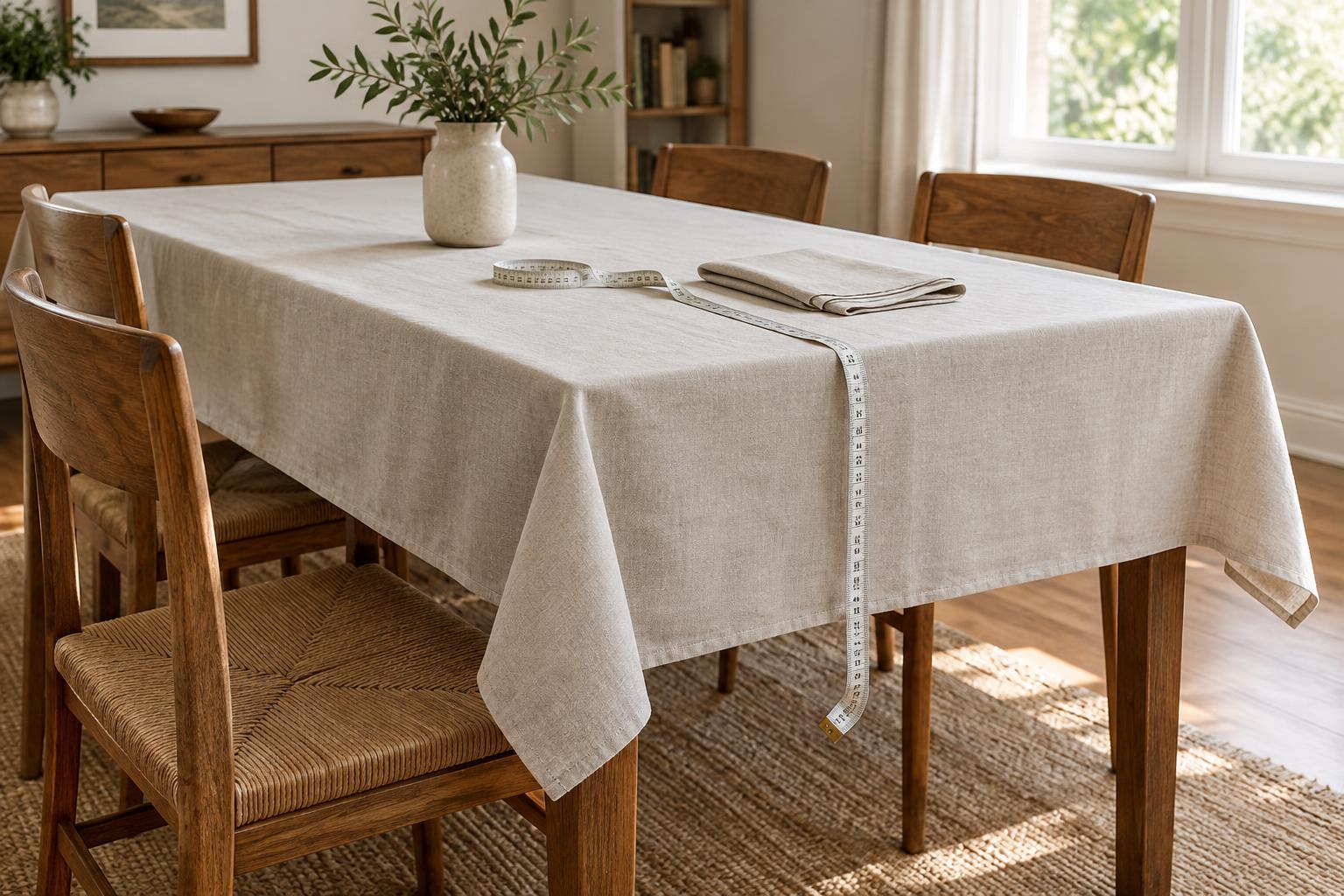
Measure the tabletop rather than relying on the table’s advertised size. For a rectangular or oval table, record its length and width at the widest points. For a square table, measure both sides; for a round table, measure straight across the center to find its diameter. If your table has leaves, measure it both closed and extended. You may want a different cloth for each setup, especially if the extended table is used often.
Check for details that affect how the cloth hangs. A thick tabletop, broad apron, or chairs with arms can make a long drop feel crowded. Try sitting at the table with a tape measure held down from the edge to see where the fabric would end. If you already own a cloth whose fit you like, measure its drop as a useful reference.
Choose a drop that suits the occasion
The drop is the distance the cloth hangs below the tabletop edge. For casual meals, a drop of roughly 6 to 10 inches (15 to 25 cm) often gives some coverage without leaving much fabric near diners’ knees. A drop around 10 to 15 inches (25 to 38 cm) creates a fuller look. These are starting points, not rules: your table height, chairs, and preferences matter more than a prescribed number.
A floor-length cloth makes a more formal statement but can be inconvenient where people need to pull chairs in and out. Measure from the tabletop to the floor before considering one, and leave a little clearance if you do not want the hem to drag. For a working table used for homework, crafts, or frequent meals, a shorter drop may be easier to keep out of the way.
Think about who uses the table, too. Loose, low-hanging fabric is easier to tug or catch when people move around it. A shorter drop can be a more practical choice in a busy household. Whatever length you choose, test it at the table rather than judging it only from a product photograph.
Calculate the cloth size
For a rectangular, square, or oval cloth, add twice your chosen drop to each tabletop measurement. For example, a table 60 inches long and 36 inches wide needs a cloth about 80 by 56 inches for a 10-inch drop on all sides. For a round table, add twice the drop to the diameter: a 48-inch table with a 10-inch drop calls for a cloth about 68 inches across.
Those calculations describe the finished cloth, including its hem, not the amount of fabric to cut for sewing. If you are making one, allow extra material for hems and any expected shrinkage. If you are buying one, compare the listed finished dimensions with your calculation. A ready-made cloth may not match exactly; decide whether you would prefer a slightly shorter or longer drop before choosing the nearest size.
Shape matters as well as dimensions. A rectangular cloth on an oval table will hang farther at the corners, while a rectangular cloth on a round table creates four longer points. Either look can be intentional, but it will not give an even drop all the way around. For an oval table, an oval cloth cut to the tabletop’s outline is the more direct route to a consistent hang.
Account for fabric and everyday care
Fabric weight changes the way a measured drop looks. A crisp fabric tends to stand away from the table, while a softer one may fall in closer folds. On a table with sharp corners, a stiff cloth can appear shorter at the corners than it does along the sides. If possible, drape a sample or an existing cloth over the table before committing to a size.
Consider washing before you settle on a close fit. Some washable fabrics shrink, especially on their first wash, so check the care information and follow any prewashing guidance if you are sewing. For a purchased cloth, a little extra length may be useful if shrinkage is possible, but avoid counting on an exact amount unless the maker specifies it. Patterns also deserve a glance: a border or centered motif may look uneven if the cloth shifts or the drop varies.
Finally, check the cloth in use. Set the table, seat the chairs, and make sure diners can move their legs without pulling at the fabric. The best size is not simply the one that matches a formula; it is the one that hangs comfortably, stays manageable during meals, and suits how you use the room.