What curtain fullness means
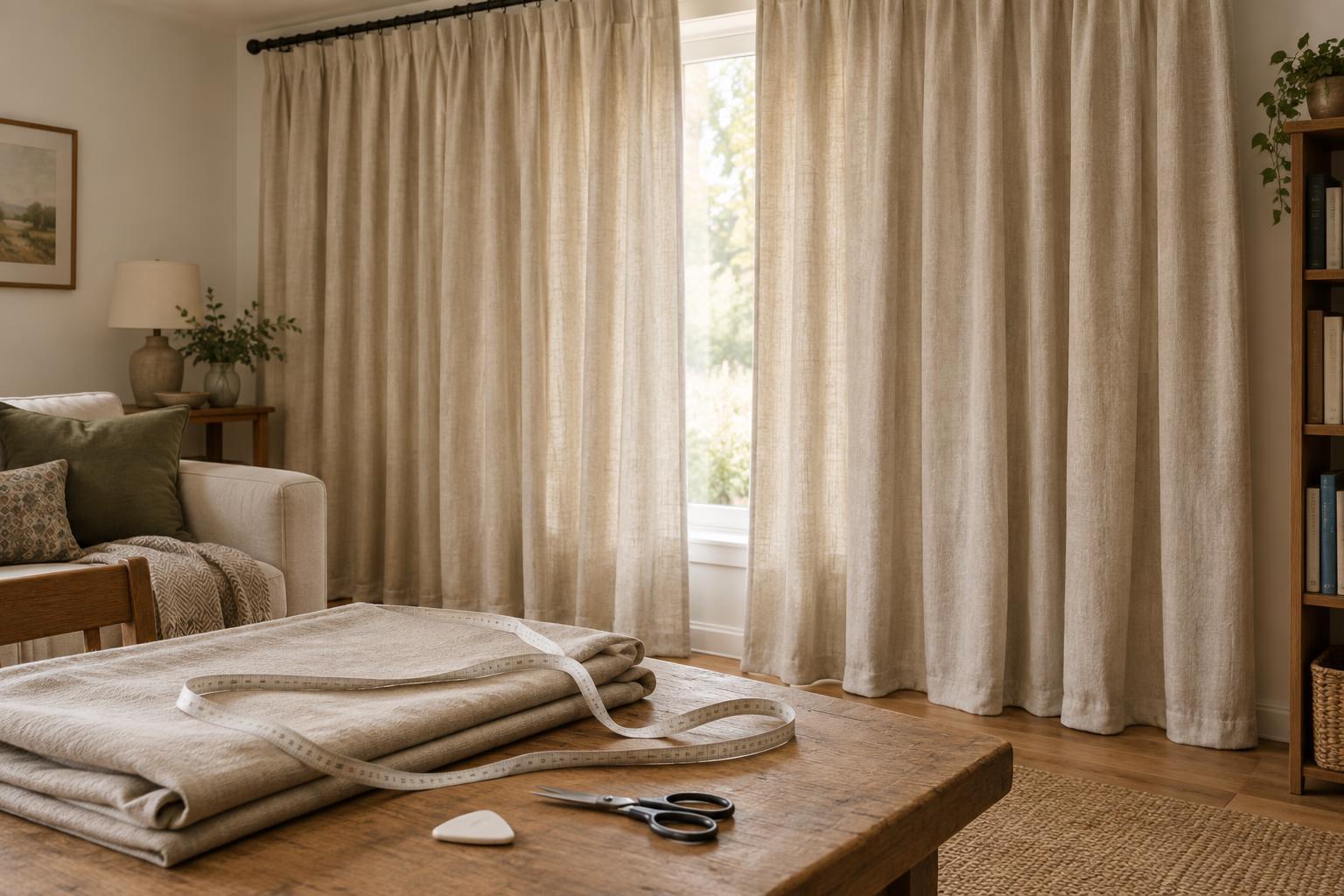
Fullness describes the relationship between the width of fabric in a curtain and the width it covers when closed. A curtain made with 2× fullness uses roughly twice as much flat fabric width as the space it needs to cover. That extra width forms the folds you see across the window; it does not make the finished curtain twice as wide.
A useful starting range for many home curtains is 1.5× to 2.5× fullness. Lower fullness gives a flatter, simpler look and can suit a bulky fabric. Higher fullness creates deeper or more numerous folds, but needs more fabric and room to stack when open. There is no single correct ratio: the fabric, heading style and look you want all matter.
Measure the space the curtains must cover
Measure the usable length of the installed track or pole rather than the window glass alone. If the track extends beyond the window, include those extensions: the curtains must cover that full distance when closed. For a pole, measure the span the rings or heading can travel, not the decorative finials. Note any centre overlap or returns at the ends of the track, since these may call for a little extra coverage.
Next, decide where the curtains will end. Measure down from the point appropriate to your heading and hardware to the intended hem position. A curtain that finishes just above the floor needs a different drop from one that sits on a sill. Take measurements at more than one point if the floor or window is uneven, and settle on a finished length before adding fabric for construction.
Choose a ratio that suits the heading and fabric
A lightly gathered curtain may look comfortable at around 1.5× fullness, while a more generous gathered or pencil-pleat curtain often uses around 2× or more. Pinch pleats consume fabric within each pleat, so their requirements depend on the number and size of pleats. Eyelet and wave-style curtains have spacing requirements of their own. If you are using a heading tape or a specialist track system, follow its specifications before buying fabric.
Fabric changes the result, too. A crisp cloth may hold visible folds with less fullness, whereas a thin sheer can look sparse at the same ratio. Thick upholstery-weight fabric can become crowded if gathered too tightly. If possible, hold a length of the chosen cloth against the pole or track and arrange a few folds. This simple check is often more helpful than treating a ratio as a rule.
Turn your measurements into fabric widths
Multiply the track width by your chosen fullness ratio to estimate the total flat curtain width. For example, a 180 cm track at 2× fullness calls for about 360 cm of flat curtain width across the pair. Each curtain would account for roughly half that total if the pair is symmetrical. This figure is a starting point, not yet the amount of fabric to buy: seams and side hems will use some width.
Check the usable width of the fabric, then work out how many vertical fabric widths you need. Three widths of 140 cm cloth provide 420 cm before construction. In the example above, that leaves some room for joins and side hems while still approaching the 360 cm target. The exact allowance depends on how you make the curtains. If your calculation is close, do not assume a partial width will be enough without planning where its seams will fall and how the panels will balance.
Calculate the length to buy
For each vertical fabric width, start with the finished drop and add allowances for the top heading and bottom hem. Suppose the planned finished drop is 240 cm, with 10 cm allowed at the top and 15 cm at the bottom. Each cut length would be 265 cm. If the curtains require three fabric widths, that is 795 cm, or 7.95 m, before any extra needed for matching or cutting.
Patterned fabric may require each cut length to start at the same point in the design. If the pattern repeats every 30 cm, a 265 cm cut may need to be rounded up to 270 cm per width, making three widths 8.1 m. A prominent motif may need additional planning so it sits where you want it on both curtains. Also check whether your fabric needs preparation for shrinkage, and calculate lining separately if you plan to add it. A final sketch showing the track, each panel, joins, hems and cut lengths makes it easier to catch an omission before you purchase.