Start with the window and your routine
A bedroom curtain has several jobs, but it does not need to perform all of them at once. Think about when you need darkness, when you want daylight, and whether you sleep with the window open. A street-facing bedroom may call for privacy throughout the day, while a room overlooking a garden may need covering mainly at night. Noting these habits first makes fabric and hardware choices easier.
Look closely at how the window opens. A curtain that hangs neatly over a closed window might block an inward-opening sash or catch in a breeze. Check where the handles, radiator and any furniture sit, and leave room to draw the curtains fully aside. If fresh air matters to you, plan a way to open the window without having to bundle fabric against it.
Choose the level of darkness you need
Fabric thickness alone does not tell you how dark a room will feel. A dense weave and a lining can reduce the light passing through a curtain; a blackout lining is useful if you prefer a darker sleeping space. Even then, light may enter around the edges. Curtains mounted above the window and extending beyond its sides generally cover those gaps better than panels fitted close to the glass.
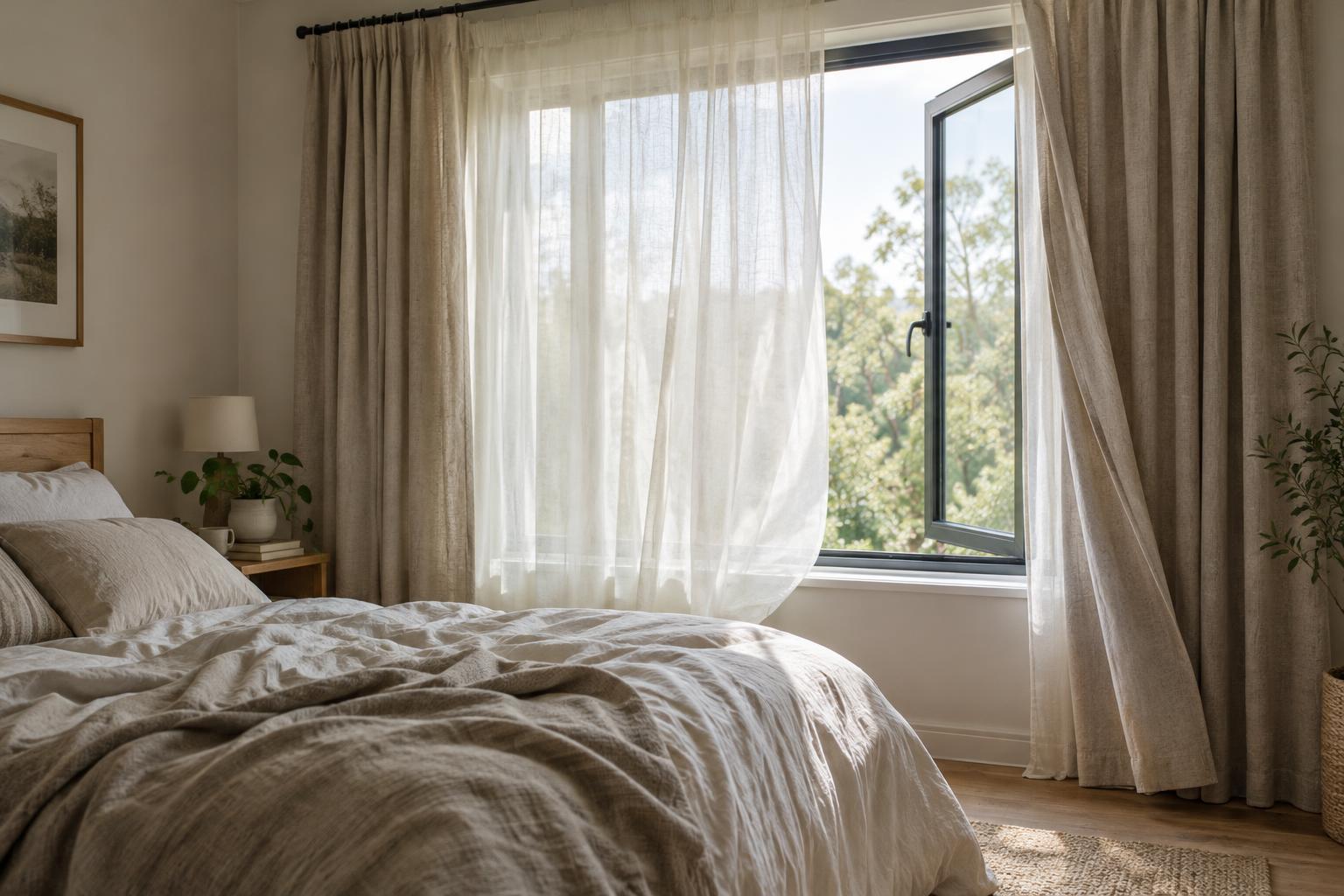
For a flexible setup, pair substantial curtains with a lighter window covering. You can close the main curtains when you want darkness and use the lighter layer when you want daylight without leaving the window fully exposed. Before buying, hold fabric samples up to a bright window if possible. Colours and textures that look similar on a table can transmit noticeably different amounts of light.
Build privacy in layers
Privacy depends on more than whether a fabric is called sheer or opaque. The distance between your room and neighbouring windows, indoor lighting and the angle of view all affect what someone might see. Sheer curtains can soften a daytime view into a room, but they may offer limited privacy after dark when the bedroom lights are on. Test a sample at the window at different times rather than relying on its appearance in a shop.
A light-filtering layer with heavier curtains is one practical combination. It lets you keep some covering in place while the main panels are open. If you prefer a simpler look, a closely woven curtain may be enough, provided you are comfortable drawing it whenever privacy is needed. Whichever approach you choose, make sure the panels meet at the centre and cover the sides of the window when closed.
Make room for fresh air
Curtains can move across an open window, particularly when the breeze changes direction. Lightweight panels may be easy to pull aside, but they can also blow into the room. Heavier lined panels tend to stay put more readily, though their bulk can make it harder to reach a window. Consider where the curtain will rest when open and whether a tieback or holdback would keep it clear without straining the fabric.
For ventilation with privacy, you might open the window behind a light layer and draw the heavier panels aside. How well this works depends on the window style and the breeze. Keep fabric away from heaters and avoid trapping it in window hardware. In rooms prone to moisture on the glass, leave enough access to check and wipe the window area; curtains should not make that routine difficult.
Finish with fit and care
Measure the window and the space around it before choosing a curtain length. A wider pole or track allows the open panels to sit beyond the glass, preserving daylight and access to the window. Allow enough fabric across the width for the curtains to close without pulling tight. For the length, decide whether you want a small clearance above the floor, which can make regular cleaning easier.
Bedroom curtains collect dust over time, so check the fabric and lining care labels before purchase. Some combinations are easier to vacuum gently than to wash at home, while others can be laundered if the labels allow it. Choose hardware you can operate comfortably, and keep cords or other loose operating parts out of children’s reach. A good arrangement should feel straightforward to use every day, not just look right when freshly hung.